

The site that built itself
An AI app generator builds you a website in an afternoon. Then comes the day you want to take it with you. The story of a rescue, and of why AI needs a template jig.
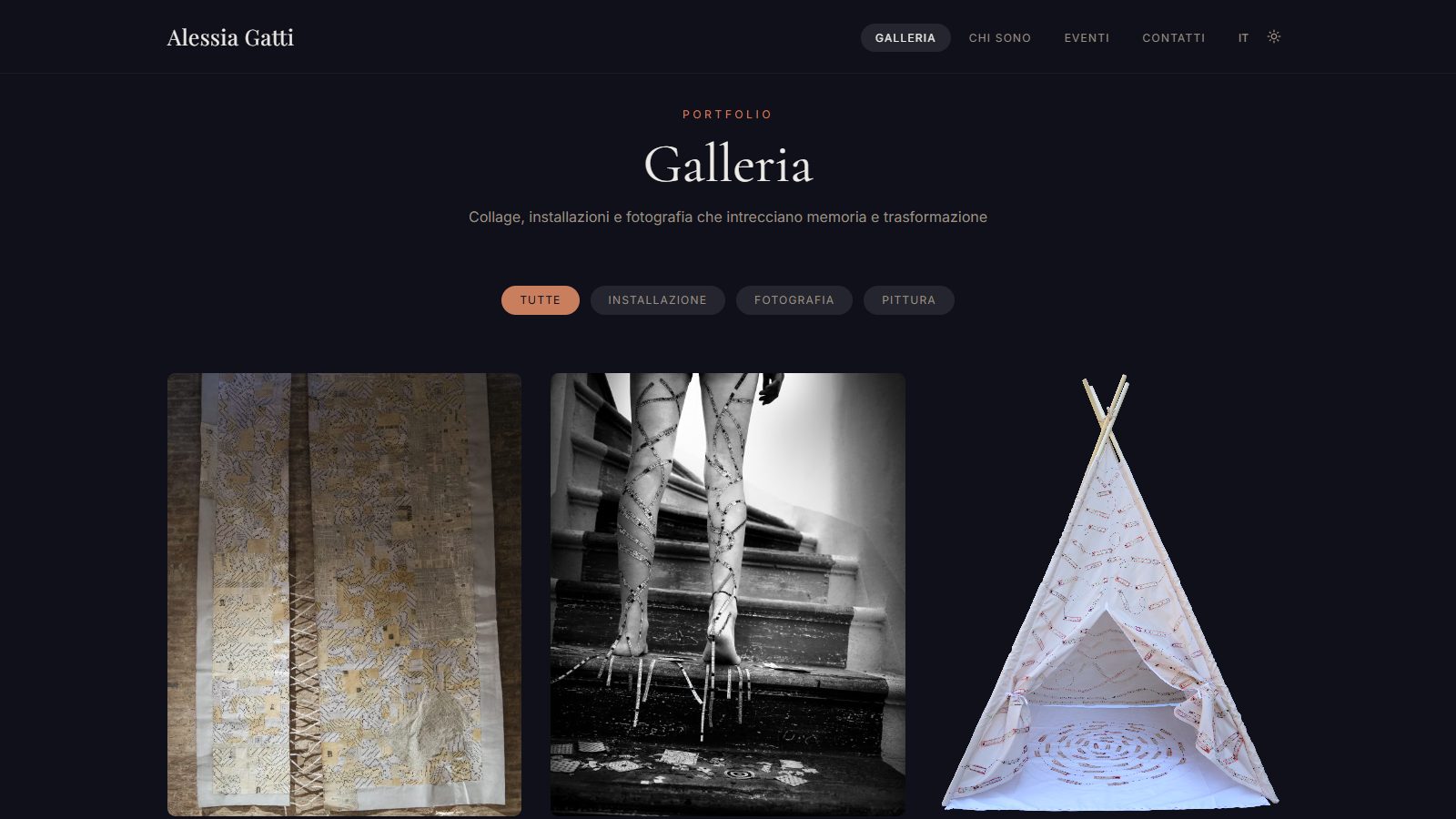
One afternoon, one well-written description, and there is the site: pages, a gallery, a panel to update it. The portfolio of Alessia Gatti, a visual artist working with collage, installation and photography, was born that way, with an AI app generator. And it was beautiful. The problem was not how it looked. It was where it lived.
One afternoon, one website
AI app generators do something that looked like magic until yesterday: you describe what you want and you get a complete app, with interface, database and admin panel. For an idea to test, for a demo, for a prototype to show tomorrow morning, they are an extraordinary tool. Nothing about it is fake: the site works.
A house without foundations
What you don't see is underneath. The content lives in a platform database that you cannot download with one click. The images sit in a storage space that exists as long as the subscription does. The structure of the pages is decided by the model, case by case: every section is built "its own way", and no rule says that an artwork must have a year, a medium, dimensions.
As long as you stay there, all is well. The day you want to move house, you find out there is no removal van: there is a rebuild.
Save first, argue later
The rescue started from the public pages of the site, still switched on. From there we rebuilt everything: 26 artworks, 5 events, 4 exhibitions, the texts in Italian and English, 50 original images. And we noted down every old address, because a site that changes its addresses loses in one day what Google gave it over years.
There was no data schema, so we worked it out from the data itself: which information every artwork has, which only some have, what tells an event apart from an exhibition.
The jig
This is where the CMS comes in. On Joomla 6.2 everything has a shape decided before, not after: an artwork has a title, medium, year, dimensions, a gallery of details with captions; an event has dates, a venue, links and documents. Italian and English are linked page by page. The addresses are the same as before, and where they could not be, there is a redirect.
It is a jig, in the carpenter's sense: the template that makes every piece come out the right size. The design, re-tailored on the original, is only the suit. What makes the difference is underneath.
AI + CMS, not AI instead of a CMS
In this job the AI did a great deal: it read the pages, extracted the data, wrote the import scripts, translated, checked. But it worked inside a structure, not instead of one. The CMS keeps, validates and makes everything portable; the AI produces, fast, inside those rails. An instrument plays better if somebody tuned it first.
Today Alessia's site is back on its own domain, alessiagatti.it, updated from a panel that depends on no platform. And the next AI tool she uses will find a house with foundations.
Three questions before you have a site generated
- Where is my data, and how do I take it away? If the answer is "we'll see", you will.
- Can I change provider without rewriting everything? Text, images and structure must be able to leave in a format another system understands.
- Do the addresses survive a move? Pages move house; the links pointing at them don't.
If the three answers are clear, the generator is a great start. If they are not, it is a great prototype.